
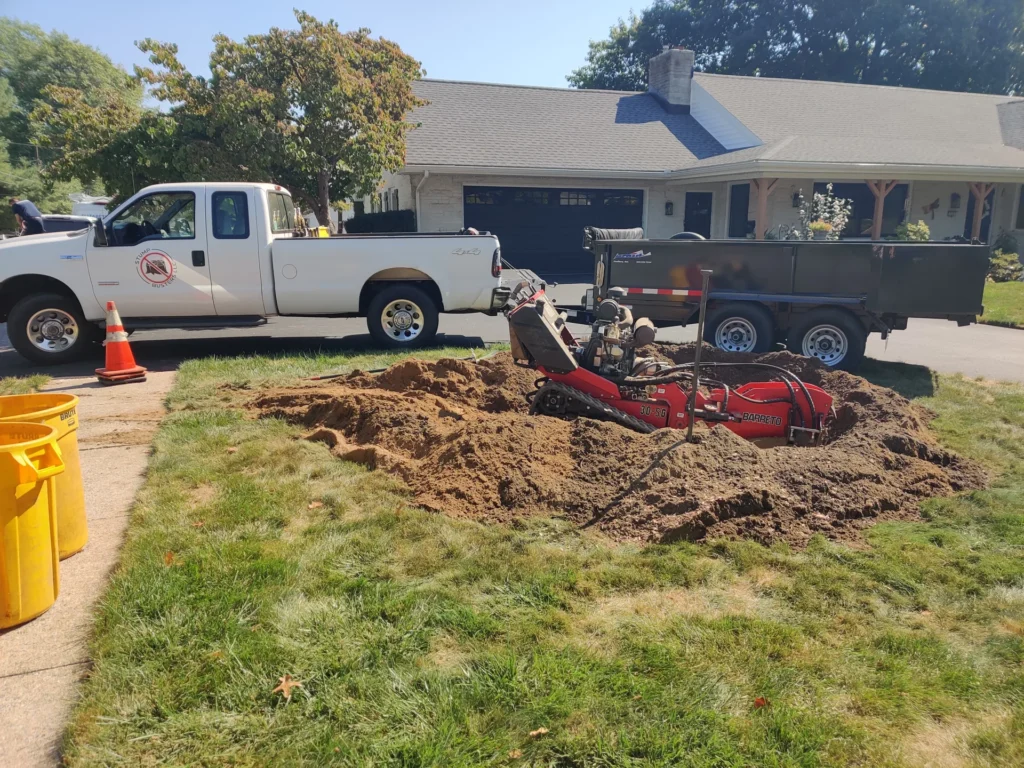
Stump grinding cleanup is the part of the job most homeowners never think about until the grinder is loaded up and gone. Grinding a stump leaves behind a mound of shredded wood, bark, root pieces, and dirt. Sometimes it fits in a wheelbarrow. Sometimes it’s the size of a small car. What happens to that pile next is the difference between getting your yard back and staring at a mess for the next year or two.
Here are six reasons that pile shouldn’t stay on your property, and what good cleanup looks like when the job is done right. None of this is just our opinion, either. The claims below come from university extension research, and we’ve linked the sources so you can read them yourself.
First, what’s actually in that pile
People tend to assume stump grindings are basically mulch. They’re not. Grindings are a loose mix of shredded wood, bark, root fibers, native soil, and whatever stones the roots grew around. A grinder cuts six to twelve inches below grade and chews through the major roots, which is why the pile usually ends up two to three times the volume of the stump you saw above ground. Even a modest 18-inch stump can leave a mound several feet across.
Grindings also aren’t the same thing as arborist wood chips. Chips come from clean limbs and branches run through a chipper, and they make a decent mulch. Grindings come out of the ground, so you get dirt, roots, and sometimes half-rotted or fungus-ridden wood mixed in. That difference is behind most of the problems below.
The six reasons
1. Your grass won’t grow back there
When fresh wood debris sits on bare soil, the microbes breaking it down pull nitrogen out of the top few inches of ground to fuel the job. Soil scientists call it nitrogen immobilization. Deep-rooted trees and shrubs don’t really notice, but grass lives in exactly the layer that gets robbed. Washington State University Extension covers this in its research on wood chip mulch, and U.S. Forest Service research found that heavy woody debris can hold back plant growth around it for years while that nitrogen stays locked up.
So a pile of grindings left on the lawn means a dead spot that won’t green up for one to three growing seasons, no matter how much seed and water you throw at it.
2. It gives pests a bridge to your house
Let’s get the termite claim straight first, because plenty of companies overstate it. Wood chips don’t “attract” termites the way the scare stories say. Dr. Linda Chalker-Scott’s WSU Extension fact sheet found that woody mulches on their own aren’t strongly attractive to subterranean termites.
The real risk is spelled out in the same document: “Although wood chips do not attract termites or other pests, they and other mulches can act as a bridge allowing pest insects to enter houses and garages. Maintain a narrow strip of bare soil next to the foundation to prevent infestations.”
A damp pile of grindings sitting near your foundation is exactly the bridge they’re talking about.
Carpenter ants work differently. They aren’t after food. They’re hunting for soft, moisture-damaged wood to nest in, and a wet grinding pile fits the bill. Penn State‘s prevention advice is blunt: remove stumps, logs, and waste wood within 100 yards of the building. North Carolina State Extension lists “tree stumps, logs, standing dead trees” as typical nesting sites for the black carpenter ant (Camponotus pennsylvanicus), a species literally named for Pennsylvania and common all over central PA.
Termites are here too. The Eastern subterranean termite (Reticulitermes flavipes) lives throughout the state, and Penn State Extension blames it for serious structural damage every year. We wrote a full post on how termites go after leftover wood, so if pests are your main concern, read the termite breakdown here.
To be clear, a pile of grindings won’t spawn a termite colony out of nowhere. But when a colony already exists within foraging range, and in Lancaster, York, Dauphin, and Lebanon counties plenty do, a moist debris mound gives them cover and a protected route toward the house.
3. If the tree was diseased, the grindings are too
Almost nobody brings this one up. If the tree you removed was sick, especially with Armillaria root rot (also called shoestring rot or honey mushroom rot), the grindings carry the infection with them.
Armillaria is a soil-borne fungus that kills trees and shrubs of nearly every species. UC IPM and the University of Wisconsin Horticulture Extension both describe how it survives for decades in leftover root and stump tissue, then spreads to nearby healthy trees through root contact or through rhizomorphs, the rope-like fungal strands that push through soil looking for new hosts. UC IPM recommends removing or grinding stumps and large roots because it reduces the amount of Armillaria in the landscape. That only works if the infected material actually leaves. Pile the grindings in a corner of the yard and you’ve kept the fungus in play, just closer to the trees you want to protect.
If the stump looked rotted, had honey-colored mushrooms growing at the base, or showed white fan-shaped fungal tissue under the bark, treat the grindings as contaminated. They don’t belong anywhere on your property.
4. The pile settles into a sinkhole
Grindings decompose, and they do it unevenly. A three-foot mound can shrink into a one-foot depression inside the first year, then keep sinking for several more. If the grindings get spread across the lawn or shoveled back into the stump hole as fill, you end up with a slow-motion sinkhole where the tree used to be. Deep enough to catch a mower tire, trip a kid, or pool water where you never wanted it.
The only real fix is to haul out the bulk of the grindings and let native soil fill the hole instead.
5. Large piles are a real fire risk
This sounds dramatic until you look it up. Decomposing wood generates its own heat. In a big enough pile that heat can’t escape, temperatures keep climbing, and eventually chemical oxidation takes over. That’s the mechanism behind spontaneous combustion, and both Purdue University Extension and insurance risk guidance from The Hartford document it. Mulch and wood chip pile fires are a regular event at landscape supply yards, and a homeowner-sized pile isn’t immune when it’s packed tight and left wet.
Will a leftover grinding pile burn your house down? Probably not. But leave a big one sitting wet through the summer and you might catch it smoldering by late August.
6. It’s an eyesore that gets worse, not better
A grinding pile doesn’t blend into a yard. It’s darker than the soil around it, it’s lumpy, it shifts after every hard rain, and it hangs around for a year or more. If you’re selling the house, running a business with visible grounds, or just want your yard back, it’s a problem you can see from the street. And the longer it sits, the bigger the dead patch under it grows.
What the industry’s own standards say
Professional tree care has written standards, and cleanup is in them.
The ANSI A300 series, maintained by the Tree Care Industry Association, is the American National Standard for tree care work. It’s what ISA Certified Arborists train under, and it treats pruning, removal, and stump work as one complete operation, debris management included. The International Society of Arboriculture builds its certification program around the same standards.
By the industry’s own standards, cleanup is part of the job, and that’s how we quote it.
The questions we hear most
And how we answer them:
- Is debris haul-away included, or extra? Included, in writing, on every quote we send.
- What happens to the hole? The native soil rises to the top as we grind and fills it back in. Where settling is likely, we crown it slightly so it doesn’t end up a divot. The grindings don’t go back in.
- What if the stump turns out to be diseased or rotted? The infected material leaves the property with us. It never gets mixed back into the hole.
- Do you work to the industry standards? Yes. The ANSI A300 cleanup practices described above are how we run every grind.
- Can I walk the site with you before you leave? Always. We ask you to. If something needs another pass, we make another pass.
How StumpBusters handles stump grinding cleanup
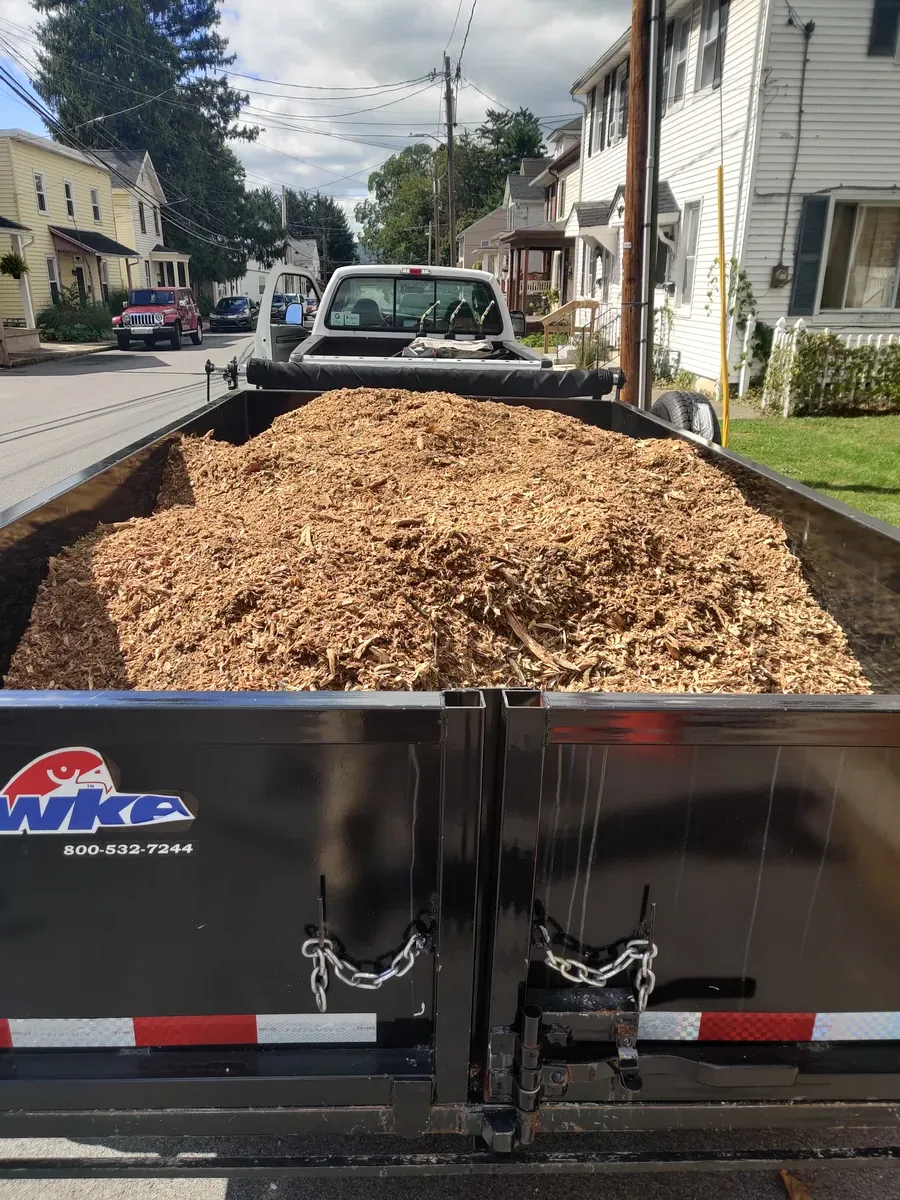
Every StumpBusters quote includes hauling the grindings off your property. It’s not an upgrade and it’s not a separate line item. It’s just part of the job, and when we leave, the pile leaves with us.
We can do that without padding our quotes because of how we grind. The cutter wheel works the stump down through the root ball while the native soil underneath rises up through the debris. By the time we scoop out the grindings, the hole has mostly refilled itself with the same subsoil the roots were growing in. A few loose wood chips stay mixed in at the top, and that’s fine. There aren’t enough to bother grass seed, they break down within a season, and the spot usually just needs a quick rake to sit flat.
If the site needs more than that, maybe a very large stump, a diseased tree, or a lawn you want green again right away, we offer topsoil delivery and grass seeding too. Most jobs don’t need them. The soil that comes up during grinding is usually all the fill the area needs, and we’ll tell you which situation you’re in before we quote anything extra.
All of it is backed by our Zero-Risk Guarantee. If the job isn’t right when we’re done, we make it right.
If you’re in Lancaster, York, Dauphin, or Lebanon County and you’ve been putting off a stump because you didn’t want a pile to deal with afterward, call us at (717) 468-1978 or request a quote online.
Frequently asked questions
Is haul-away included in a StumpBusters quote?
Yes, always. Hauling the grindings off-property is part of every quote we write, not an add-on or an upgrade. When we leave, the pile leaves with us.
Is it bad to leave stump grindings in my yard?
A small amount spread thin, away from the foundation and around established trees or shrubs, is usually fine. A large pile is a different story. It kills the grass underneath through nitrogen immobilization, gives carpenter ants and other wood-nesting pests a place to live, can carry fungal pathogens like Armillaria root rot, settles into a depression over time, and at larger volumes can even become a spontaneous combustion risk.
Will leftover stump grindings attract termites?
Not directly. WSU Extension research shows wood chips on their own aren’t a strong termite attractant. The real risk is that a pile near the house acts as a bridge, giving a colony that already lives nearby a protected route to your foundation. Eastern subterranean termites are found throughout Pennsylvania, which is why Penn State Extension recommends keeping waste wood well away from structures.
Can I use stump grindings as mulch?
Sometimes. Grindings contain more soil, roots, and stones than clean arborist wood chips, so they make a rougher mulch. If the tree was diseased, don’t reuse the grindings anywhere in the landscape. If it was healthy, a thin layer around established trees or shrubs works, as long as it stays off the trunk and away from the foundation. Never use fresh grindings around vegetables or shallow-rooted annuals.
How long do stump grindings take to decompose?
Two to five years, depending on the wood species, moisture, and how exposed the pile is. Dense hardwoods like oak, hickory, and maple break down slowest. The whole time, the pile keeps settling, holding moisture, and smothering the turf underneath. That’s why hauling the bulk away on grinding day is almost always the right call.















Makes sense i guess. Rotting wood=termites
Really helpful information! The cleanup after stump grinding can make a big difference in how quickly a yard is ready for new grass, plants, or other improvements. Thanks for sharing these tips.
stuff is great for compost layers. just needed to add that.
You dont want termites BELIEVE ME ! . Ask me how i know. 2200 bux later
I under estimated the size of the chip pile left over when i had them grind my huge maple. I for sure will pay extra to have it hauled away next time.
I have been burned on this before, the size of the waste pile left behind for not even a big stump ? . CRAZY
Dont under estimate the size of the pile lol
Pingback: Tree Stumps: The Hidden Danger in Your Yard - StumpBusters LLC